

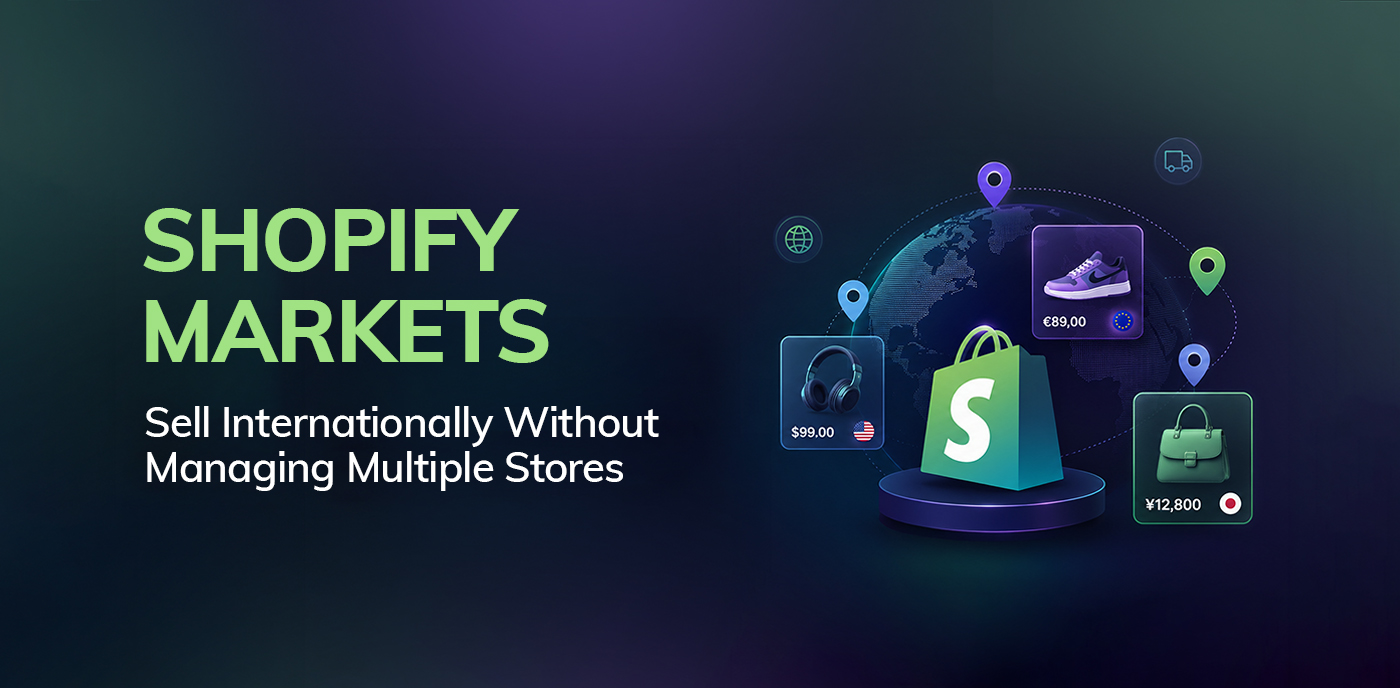

Expanding internationally used to mean creating separate stores, maintaining different inventories, managing multiple currencies, and dealing with complex tax and shipping requirements. For many merchants, these challenges made global expansion expensive and difficult to scale.
Shopify Markets changes that approach.
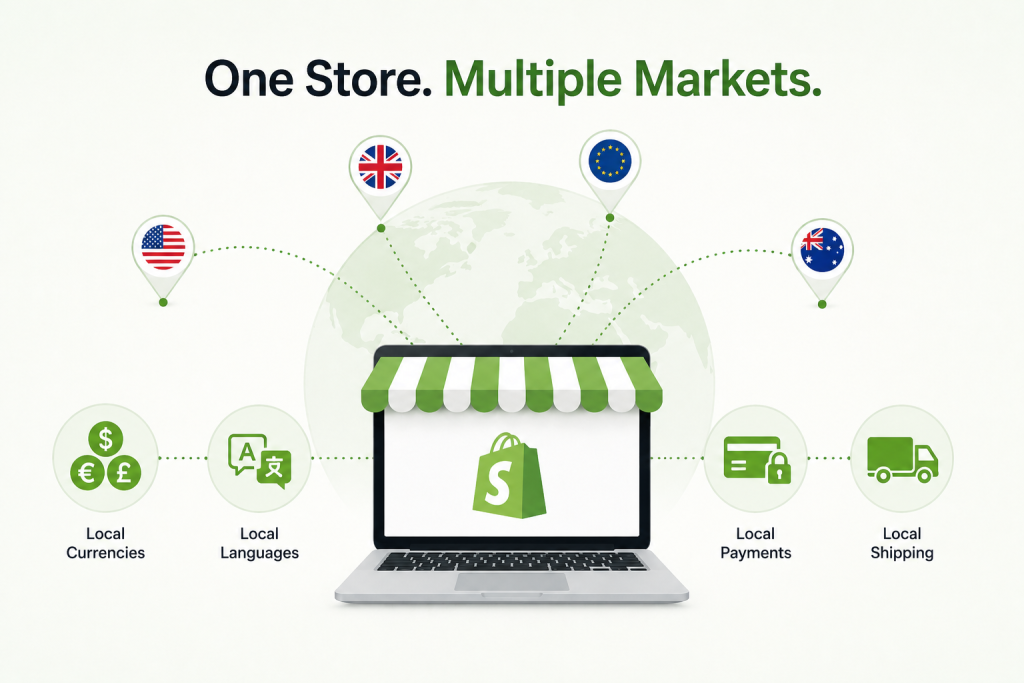
With Shopify Markets, businesses can sell to customers worldwide from a single Shopify store while providing localised experiences based on country or region. Merchants can customise currencies, pricing, domains, languages, taxes, and shipping settings without maintaining separate storefronts.
Whether you’re an established ecommerce brand or a growing business looking to enter new markets, Shopify Markets offers a scalable way to reach international customers without multiplying operational complexity.
Why International Expansion Matters More Than Ever
Cross-border ecommerce has experienced tremendous growth over the past decade. Consumers no longer limit purchases to local stores. They expect brands to provide:
- Local currencies
- Familiar payment methods
- Transparent taxes and duties
- Region-specific pricing
- Fast and reliable shipping
- Localised content and language
According to Shopify, stores that localise the shopping experience tend to achieve better conversion rates because customers feel more comfortable buying from brands that understand their preferences.
However, providing these experiences traditionally required multiple websites and extensive management overhead.
Shopify Markets solves these challenges by centralising international commerce under one platform.
What Is Shopify Markets?
Shopify Markets is Shopify’s cross-border commerce solution that enables merchants to manage multiple countries and regions from a single Shopify admin.
Instead of operating separate stores for the US, UK, Europe, Australia, and other regions, businesses can create individual markets within one store and customise each market according to customer expectations.
This allows merchants to:
- Sell in local currencies.
- Display region-specific content.
- Customise pricing by country.
- Set local domains and languages.
- Calculate duties and taxes.
- Offer local payment methods.
- Manage international shipping policies.
- Track performance market by market.
Why Multiple Stores Become Difficult to Manage
Many growing brands initially create separate Shopify stores for different countries. While this approach works, it introduces several challenges.
Inventory Synchronisation
Managing stock across multiple stores often requires third-party tools and manual intervention.
Product Updates
Every product change must be replicated across several stores.
Theme Maintenance
Updates and design changes need to be implemented multiple times.
Increased App Costs
Many apps charge per store, increasing monthly expenses.
Marketing Complexity
Managing analytics and customer data across several stores becomes fragmented.
Higher Development Costs
New features must be developed and tested separately for each storefront.
Shopify Markets eliminates many of these challenges by centralising operations.
Key Features of Shopify Markets
1. Multi-Currency Selling
Customers are more likely to complete purchases when prices appear in their local currency.
Shopify automatically converts prices based on exchange rates and supports dozens of currencies.
Examples:
- US customers see USD.
- UK customers see GBP.
- European customers see EUR.
- Australian customers see AUD.
Localised pricing improves customer trust and reduces confusion during checkout.
2. Market-Specific Pricing
Currency conversion alone may not protect profit margins.
Different countries have varying:
- Purchasing power
- Tax structures
- Competition
- Shipping costs
Shopify Markets enables merchants to create market-specific pricing adjustments.
For example:
| Market | Price Adjustment |
| United States | Base Price |
| United Kingdom | +5% |
| Europe | +8% |
| Australia | +10% |
This flexibility helps maintain profitability across regions.
3. Language Localisation
Language plays a major role in customer experience.
Shopify Markets integrates with translation solutions to deliver content in multiple languages, including:
- English
- French
- German
- Spanish
- Italian
- Japanese
Localised product descriptions and policies increase customer confidence and support SEO in different regions.
4. Country-Specific Domains
Businesses can create:
- example.com
- uk.example.com
- example.com/fr
- de.example.com
Localised URLs improve:
- Search visibility
- User experience
- Trust
- Regional branding
Customers immediately recognise that the site serves their country.
5. Duties and Import Taxes
Unexpected fees at checkout are one of the biggest reasons customers abandon purchases.
Shopify Markets helps merchants calculate:
- Import duties
- VAT
- Taxes
Showing these charges upfront creates transparency and improves customer satisfaction.
6. Local Payment Methods
Different countries prefer different payment methods.
Examples include:
United States
- Credit cards
- PayPal
Netherlands
- iDEAL
Germany
- Klarna
Belgium
- Bancontact
India
- UPI and cards
Supporting familiar payment methods significantly improves conversion rates.
7. Market-Based Shipping
Shipping expectations differ across countries.
Shopify Markets enables businesses to define:
- Shipping rates
- Delivery times
- Carrier options
- Free shipping thresholds
Each market can have its own shipping strategy.
How Shopify Markets Improves SEO
International SEO is often overlooked during expansion.
Shopify Markets supports SEO by providing:
Localised URLs
Search engines understand regional targeting.
Example:
- yourstore.com/en-us
- yourstore.com/en-gb
- yourstore.com/fr-fr
Hreflang Tags
Shopify automatically handles hreflang implementation, helping search engines deliver the correct language and region to users.
Region-Specific Content
Localised descriptions and keywords help attract customers from different countries.
Better User Experience
Lower bounce rates and higher engagement contribute positively to SEO performance.
How to Choose Markets for Expansion
Not every country should be targeted simultaneously.
Consider:
Existing Traffic
Review Google Analytics to identify countries already visiting your store.
Current Orders
Analyse international sales patterns.
Shipping Feasibility
Assess delivery costs and timelines.
Competition
Study local competitors.
Product Demand
Research whether your products fit regional preferences.
Start with two or three markets before expanding further.
Best Practices for International Expansion
Localise Beyond Currency
Translation alone is not enough.
Adapt:
- Product descriptions
- Measurements
- Date formats
- Currency symbols
- Promotions
- Cultural preferences
Understand Compliance Requirements
Different countries have regulations regarding:
- Product safety
- Consumer rights
- Taxes
- Privacy laws
- Labelling requirements
Compliance should be considered before entering new markets.
Optimise Shipping Experience
Customers expect:
- Tracking information
- Fast delivery
- Transparent pricing
Reliable logistics partners are essential for international success.
Offer Local Customer Support
Providing support in local languages and time zones enhances customer trust and loyalty.
Monitor Performance by Market
Track metrics such as:
- Revenue by country
- Conversion rate
- Average order value
- Customer acquisition cost
- Cart abandonment rate
- Repeat purchase rate
Performance insights help identify profitable markets.
When Should You Consider Multiple Stores Instead?
Although Shopify Markets works well for most brands, separate stores may still make sense when:
- Different regions require completely different catalogs.
- Pricing structures vary significantly.
- Separate business entities operate in each country.
- Different teams manage regional operations.
- Independent branding is required.
For many brands, however, Shopify Markets provides enough flexibility without introducing additional complexity.
Real-World Example
Imagine a fashion retailer based in the UK selling to customers in the United States, Germany, and Australia.
Without Shopify Markets:
- Four separate stores.
- Four themes to maintain.
- Duplicate products.
- Higher app costs.
- Fragmented analytics.
With Shopify Markets:
- One Shopify store.
- Centralised inventory.
- Local currencies.
- Region-specific pricing.
- Multiple languages.
- Unified reporting.
The result is lower operational costs and a more consistent customer experience.
Future of Cross-Border Commerce
Consumers increasingly expect brands to provide personalised shopping experiences regardless of location.
As global ecommerce becomes more competitive, businesses that invest in localisation will gain an advantage over those offering generic experiences.
Shopify Markets allows merchants to scale internationally while maintaining operational efficiency, making it one of the most powerful tools for modern ecommerce businesses.
Final Thoughts
International expansion no longer requires multiple Shopify stores and complicated workflows.
Shopify Markets empowers brands to sell globally from a single store while delivering localised experiences through regional pricing, currencies, languages, domains, and shipping settings.
For businesses planning long-term growth, adopting Shopify Markets can simplify operations, improve customer experience, and unlock new revenue opportunities across international markets.
Need Help Expanding Internationally?
At Sweans, we help brands implement Shopify Markets, optimise international SEO, configure localised storefront experiences, and build scalable ecommerce solutions for global growth.
Whether you’re entering your first overseas market or managing customers across multiple regions, our Shopify experts can help you create a seamless cross-border commerce strategy.
