


Most advice on choosing a Shopify agency sounds the same. Check their portfolio. Ask about their process. Look for Shopify Plus Partner status. Make sure they offer post-launch support.
That advice is not wrong. But it is incomplete, and it is written from the wrong direction. It assumes the agency is the variable and you are simply the evaluator. In reality, some of the most expensive mistakes in Shopify development happen not because the agency was bad, but because the brand was unprepared.
After nearly two decades working with businesses from ambitious startups to global names like Casio and Zippo, we have seen both sides of this clearly. What follows is the honest version of the conversation. The one that usually only happens after something has gone wrong.
What to Do Before You Brief a Shopify Development Agency
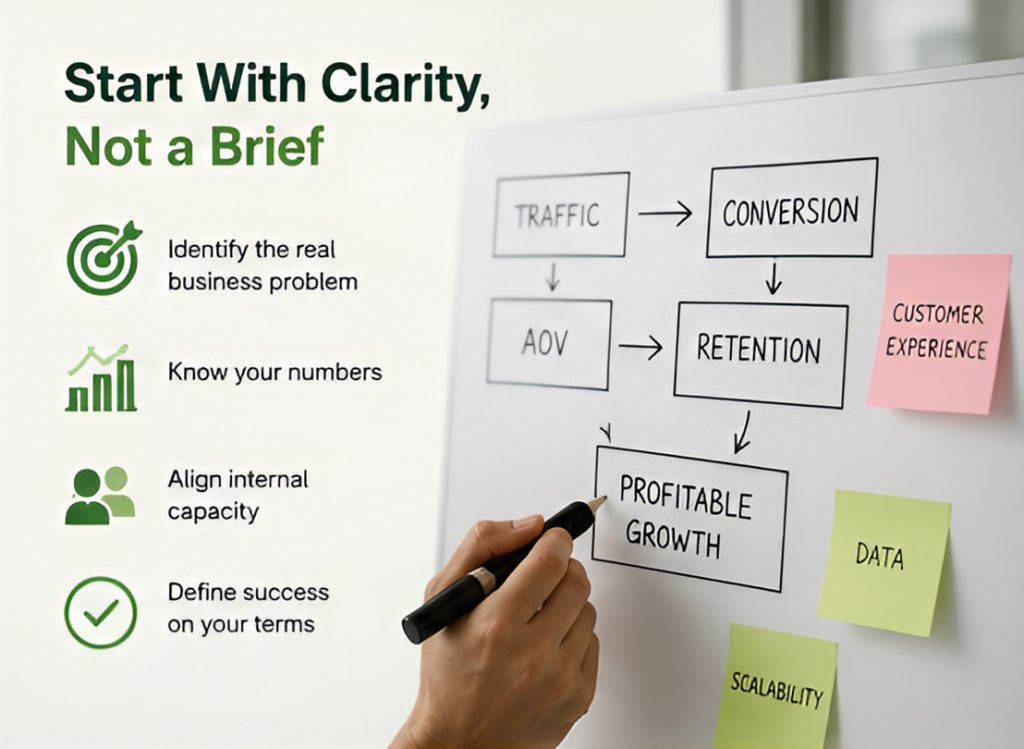
Before you open a single conversation with an agency, there are questions you need to answer internally. Skipping this step is the single biggest reason projects run over budget, drift in scope, or deliver a store that solves yesterday’s problem rather than tomorrow’s.
Start by getting clear on what is actually broken. Common root causes include:
- Slow site performance that is hurting conversion
- No ability to run promotions or update content without developer involvement
- A checkout experience that is not optimised for mobile
- Integration gaps between your store, your ERP, and your fulfilment operation
- A platform you have simply outgrown
The answer shapes everything. The type of agency you need, the timeline you should expect, and the budget that makes sense.
You also need to know your numbers before any first meeting. Be ready to share:
- Current conversion rate and average order value
- Monthly traffic and top traffic sources
- Bounce rate on key landing and product pages
- Any existing performance or Core Web Vitals data
An agency worth working with will ask for all of this in the first conversation. If you do not have it to hand, that is something to fix before you start briefing.
Finally, be honest about your internal capacity. Do you have someone who can own this project on your side, review designs, make decisions, and coordinate feedback? Projects stall most often not because agencies disappear, but because client-side sign-off takes weeks when it should take days. A good agency will build this into how they work with you. A great brief acknowledges it upfront.
Why Shopify Plus Partner Status Matters More Now
Shopify Partner and Shopify Plus Partner status has always been a reasonable signal of credibility. But at present, it carries more weight than it used to because the platform has become significantly more technically sophisticated.
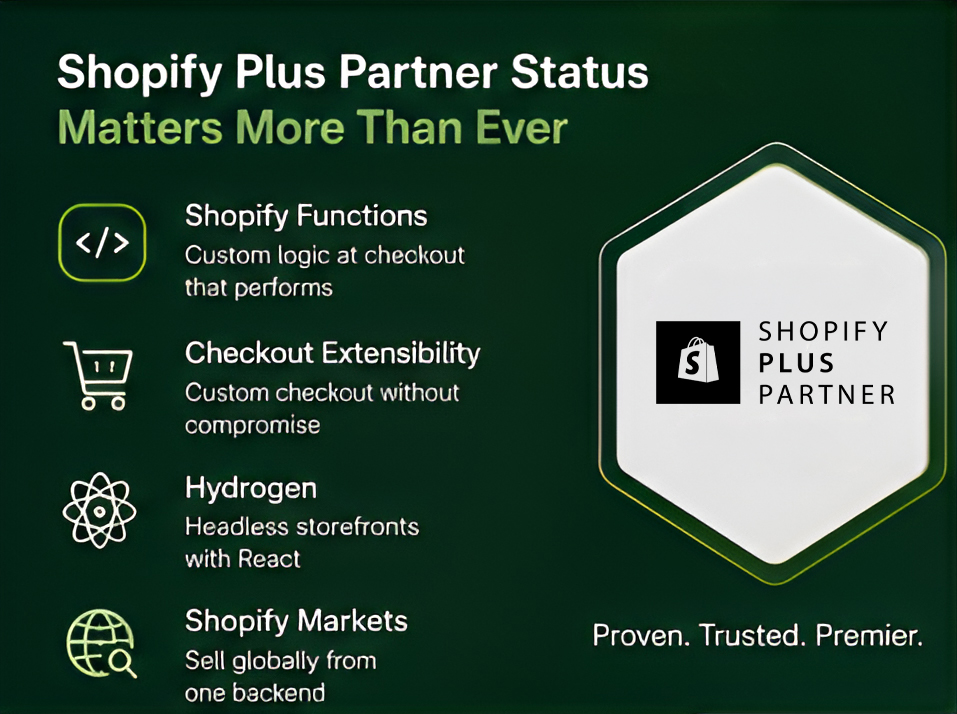
Several recent developments have raised the bar for what a capable Shopify agency needs to understand:
- Shopify Functions — custom business logic (pricing, discounts, shipping) that runs at the platform level at checkout
- Checkout Extensibility — the ability to extend and customise the Plus checkout without breaking compliance or performance
- Hydrogen — Shopify’s React-based framework for headless storefront builds
- Shopify Markets — multi-region, multi-currency, multi-language selling from a single backend
An agency that last deepened their Shopify knowledge in 2022 may have a strong portfolio and a genuine track record, yet still lack the fluency to build what modern commerce requires.
A Premier Shopify Plus Partner designation reflects active engagement with Shopify’s evolving ecosystem, including access to early feature releases, direct lines to Shopify support, and a verified track record of enterprise-level delivery. When you are building something that needs to handle thousands of orders, complex pricing logic, or multi-market selling, that depth is not optional.
When evaluating an agency, ask specifically about their experience with the current platform. Not just Shopify in general. Vague answers to specific questions are informative in their own way.
How to Evaluate a Shopify Agency’s Technical Depth (Without Being a Developer)
Most people making the final call on a Shopify development partner are commercial or marketing leads. Not engineers. This creates a real problem, because the most important differences between agencies often live in technical decisions that are invisible to a non-technical buyer until they become very expensive problems.
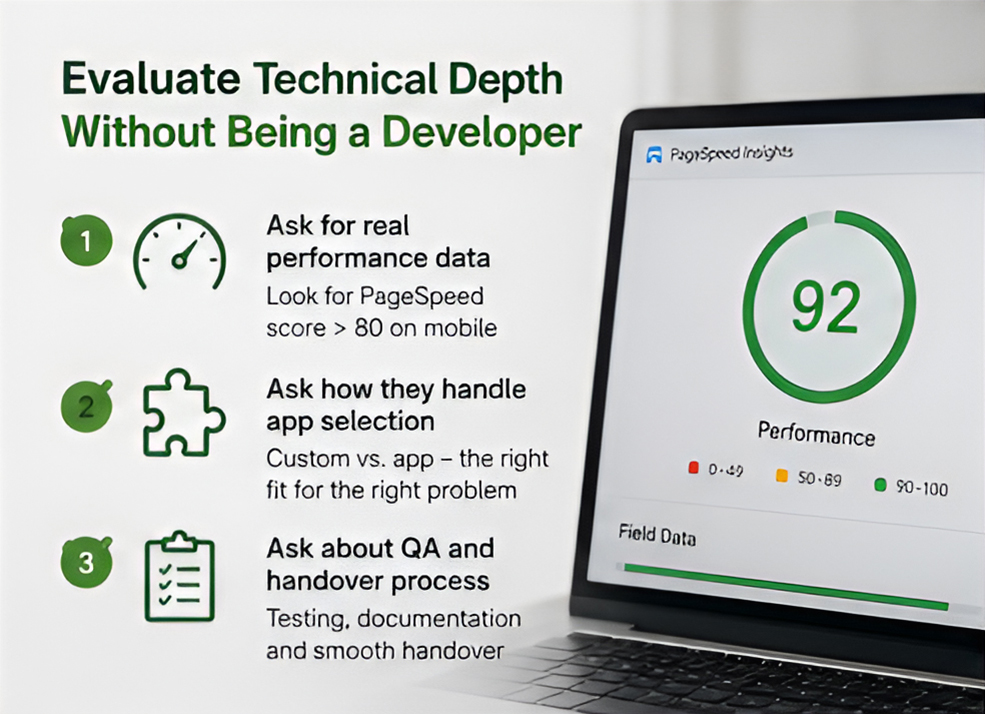
There are three practical tests you can apply without any technical background:
1. Ask for real performance data Request a PageSpeed or Lighthouse score for a store they have built recently. A well-built Shopify store should achieve a performance score above 80 on mobile. If an agency cannot point you to a live example with metrics to back it up, that tells you something.
2. Ask how they handle app selection. Shopify’s app ecosystem is powerful, but an agency that reaches for a third-party app every time they face a custom requirement is building technical debt into your store by default. A strong agency can clearly explain:
- When they would build custom functionality
- When an app is the right answer
- Why one approach is better than the other in a given situation
3. Ask about their QA and handover process. How do they test across devices and browsers? How do they handle edge cases in checkout? What does the documentation look like when they hand the store over to your team? These questions reveal process maturity, not just technical skill.
How Much Does a Shopify Development Partner Cost and What Actually Drives the Price
Pricing guides for Shopify development tend to give ranges so broad they are nearly useless. The reality is that cost is almost entirely a function of decisions, most of which are made before development begins.
Here are the choices that most significantly affect what you will pay:
- Custom design vs. a premium theme build: custom costs more upfront, but is often built to convert better for your specific audience
- ERP or CRM integration: more complex to build, but removes manual operational work at scale
- Shopify Functions vs. app-based logic: Functions take longer to develop but perform faster and do not add ongoing app subscription costs
- Headless architecture: higher build cost, but gives complete design freedom and significantly faster page performance
None of these are right or wrong decisions in isolation. They depend on your order volume, your margins, and your growth trajectory.
What consistently inflates project cost is ambiguity. Not agency pricing. Specifically:
- A brief that says “we want a premium feel” without defining what “premium” means for your customer will generate revisions
- A scope that changes significantly after development has started generates additional cost
- A decision-making process that involves multiple stakeholders without a clear owner generates delays that have financial consequences
The best way to control cost is not to find a cheaper agency. It is to arrive with clarity on your requirements, your constraints, your success criteria, and how decisions will be made on your side.
What to Expect From a Shopify Agency After Your Store Goes Live
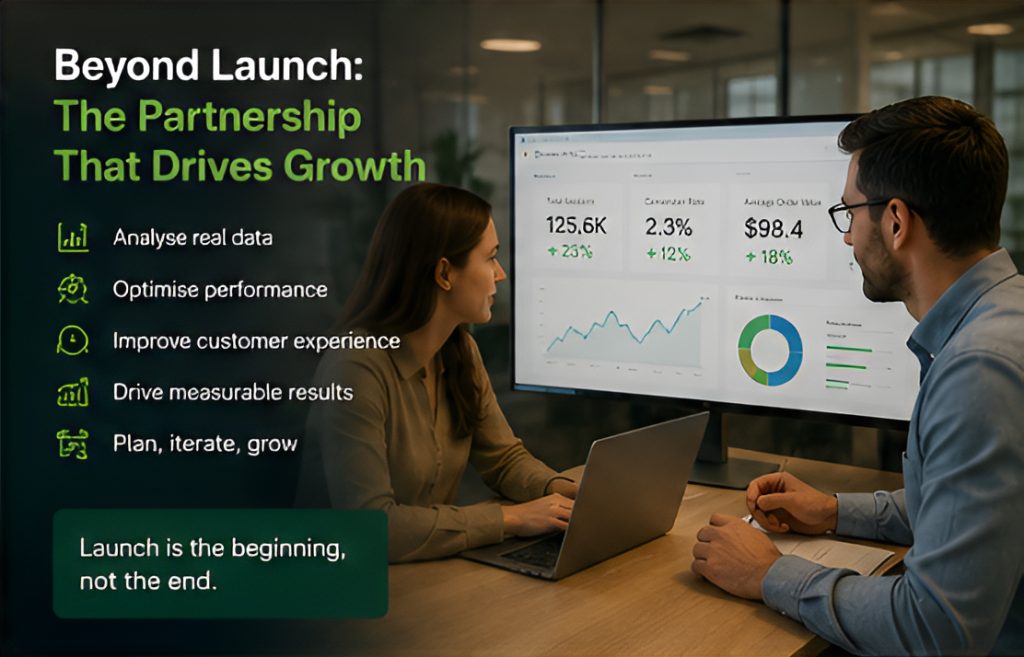
The most overlooked part of choosing a development partner is the post-launch relationship. Almost every agency mentions ongoing support in their proposal. Very few briefs actually define what that support should accomplish.
A store launch is not an endpoint. It is the moment when you finally have real data. What to look for immediately after launch includes:
- Traffic behaviour and how users move through the site
- Drop-off points in the purchase funnel
- Checkout abandonment patterns, particularly on mobile
- Search terms that are not finding the right products
- Page speed under real-world conditions vs. pre-launch testing
A development partner who understands this treats the launch as the beginning of an optimisation cycle, not the delivery of a finished product.
When evaluating agencies, ask what their retainer model actually looks like in practice:
- How are priorities set each month?
- Who owns the ongoing roadmap?
- How do they measure whether the work is generating a return?
- What does a typical monthly report look like?
A structured answer to these questions is the sign of an agency that has thought beyond the build. The relationship should end only when it stops producing value, not when the site goes live.
Shopify Development Partner Checklist: Are You Ready to Brief an Agency?
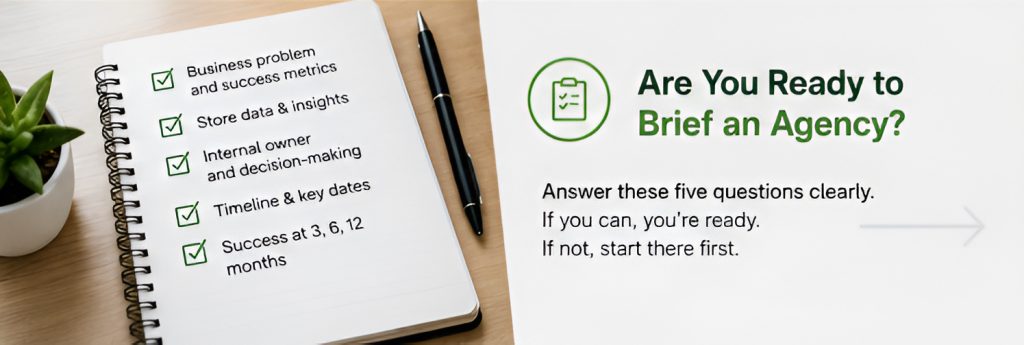
Before you speak to your first agency, work through these five questions. If you can answer all of them clearly, you are ready to brief well. If you cannot, the most valuable work you can do right now is not finding an agency. It is getting to these answers first.
- What specific business problem are we solving and how will we know when it is solved?
- What does our current store data tell us and do we have access to it and can we share it?
- Who on our side owns this project and do they have the authority to make decisions without extended sign-off chains?
- What is our realistic timeline and are there fixed commercial dates (product launches, peak trading periods) we need to build around?
- What does success look like at 3, 6, and 12 months post-launch beyond just going live on time?
The right Shopify development partner will ask you exactly these questions in the first conversation. If they do not, that is worth noting.
Final Thoughts
Choosing a Shopify development partner is not just a procurement decision, It is one of the most consequential commercial decisions a growing brand can make. The right partner does not just build your store; they shape how quickly you can move, how confidently you can scale, and how well your technology serves your customers over the long term.
The brands that get the most from these relationships are the ones that arrive prepared, ask the right questions, and treat the partnership as ongoing rather than transactional.
If you are ready to have that kind of conversation, we would like to be part of it. Sweans is a Premier Shopify Plus Partner, and since 2006 we have helped over 4,000 clients across 70+ countries launch, optimise, and scale on Shopify. Get in touch and let’s talk about what you are building.
