


Every six months, Shopify drops an Editions release. The industry spends the following weeks dissecting what changed. Most merchants spend the month after working out which of those 150+ updates actually matter to their business.
Shopify Spring ’26 is different — not in volume, but in maturity.
Where Winter ’26 built the infrastructure — variant limits, native rollouts, Sidekick as an operational layer — Spring ’26 is where that infrastructure starts generating revenue. AI commerce is live. B2B is available on every plan. The analytics suite merchants have complained about for years has been rebuilt.
Here’s what’s actually worth your attention.
AI Commerce Goes From Promise to Revenue
In Winter ’26, Shopify introduced Agentic Storefronts — the ability to syndicate your product catalogue into AI environments like ChatGPT, Copilot, and Perplexity, so products surface when shoppers ask conversational questions with purchase intent.
But discovery alone was half the equation.
A shopper who found your product inside ChatGPT still had to click out and complete a separate checkout flow.
Spring ’26 closes that gap.
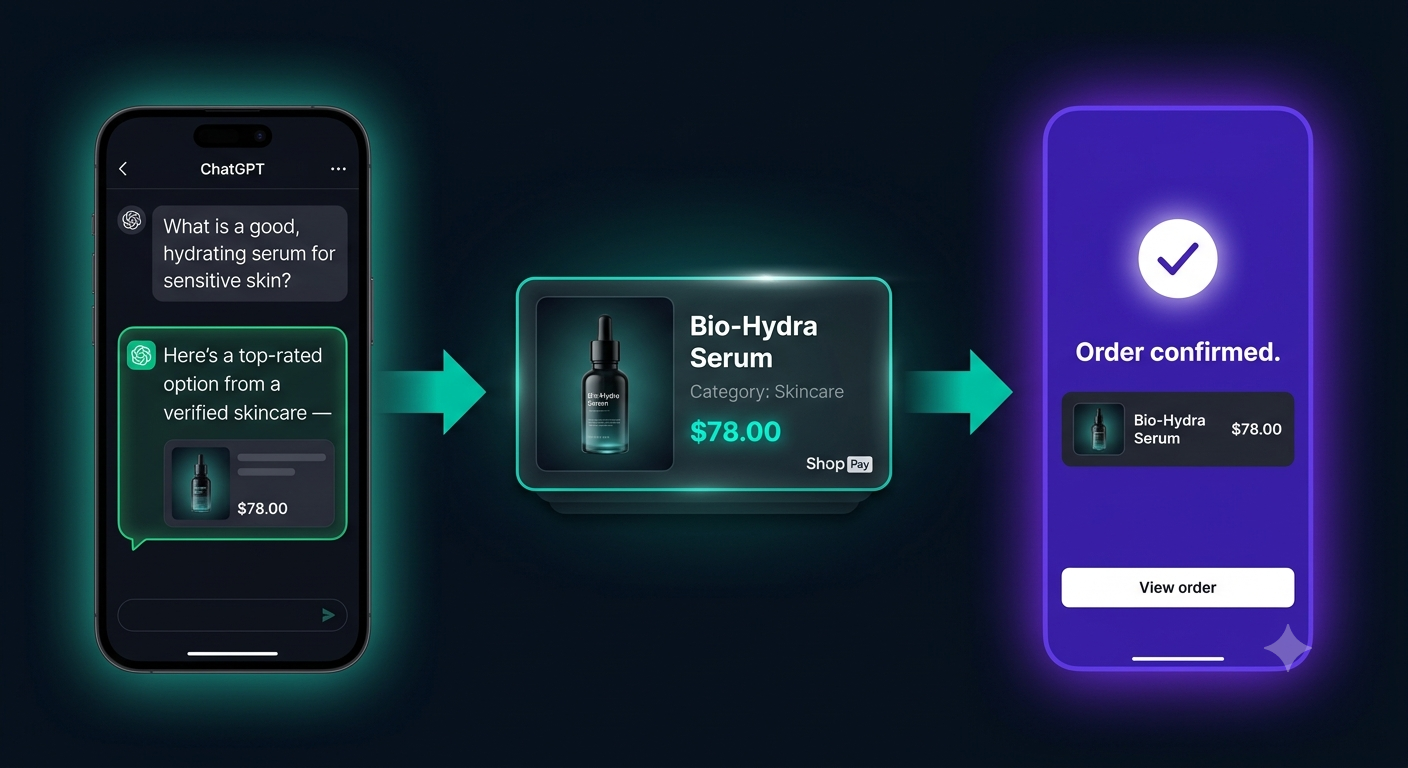
Customers can now purchase directly inside ChatGPT and Microsoft Copilot, with the transaction powered by the Universal Commerce Protocol and completed through Shop Pay — without leaving the conversation.
Shopify reports that product data syndicated through its Catalogue API drives 2x more conversion in AI chats than unsyndicated data. The structural advantage goes to merchants with clean, well-attributed product catalogues.
Best for:
- Skincare and supplements (ingredient-specific searches)
- Technical equipment and electronics (spec-driven purchases)
- Homeware and furniture (“best sofa for a small living room under £800”)
Lower impact: Fashion, gifting, and impulse-driven categories where visual discovery still leads.
Campaign Autopilot: One Tool Across Every Channel
Spring ’26 introduces Campaign Autopilot — Shopify’s first genuinely AI-driven marketing tool, designed to run campaigns across multiple channels simultaneously without constant manual adjustment.
How it works: Set a budget, define guardrails, choose an objective. Autopilot distributes spend across Shop Campaigns, ChatGPT sponsored placements, Pinterest, and Microsoft Monetize — continuously learning from performance data and shifting allocation toward what is working.
Consider a mid-size UK fashion brand running a seasonal push. Previously, that meant a dedicated media buyer, separate ad accounts, and fragmented attribution tools. Campaign Autopilot compresses that into a single managed layer.
The AI handles distribution and bidding logic. The brand keeps full control of creative assets, budget caps, and excluded channels.
Shopify is also now among the first commerce platforms to offer sponsored placement inside an AI chat environment at scale — a distribution channel that did not exist twelve months ago.
Worth noting: Autopilot manages distribution, not creative. Your assets and brand direction still determine the ceiling.
WhatsApp Is Now Built Into Shopify
Spring ’26 brings WhatsApp marketing natively into Shopify Messaging — no third-party integration, no manual webhook configuration, no separate platform to manage.
For merchants selling into markets where WhatsApp dominates — the Middle East, South Asia, continental Europe, Latin America — this removes a genuine operational headache.
What’s included:
- WhatsApp marketing campaigns created and managed inside Shopify Messaging
- SMS automations in the same interface
- WhatsApp consent tracked centrally alongside email and SMS preferences
The real-world difference: A UK supplement brand selling into the UAE previously had to use a third-party tool — Zoko, Interakt, or similar — plus a separate integration layer and separate consent tracking. That overhead is now gone.
If you have been feeling the compounding cost of too many apps, this is exactly the kind of consolidation that addresses it.
Who should care: Any merchant with meaningful customer bases in WhatsApp-dominant markets.
The Wholesale Wall Came Down: B2B on Every Plan
This is perhaps the most commercially significant change in Spring ’26 for brands in the £1M–£20M GMV range.
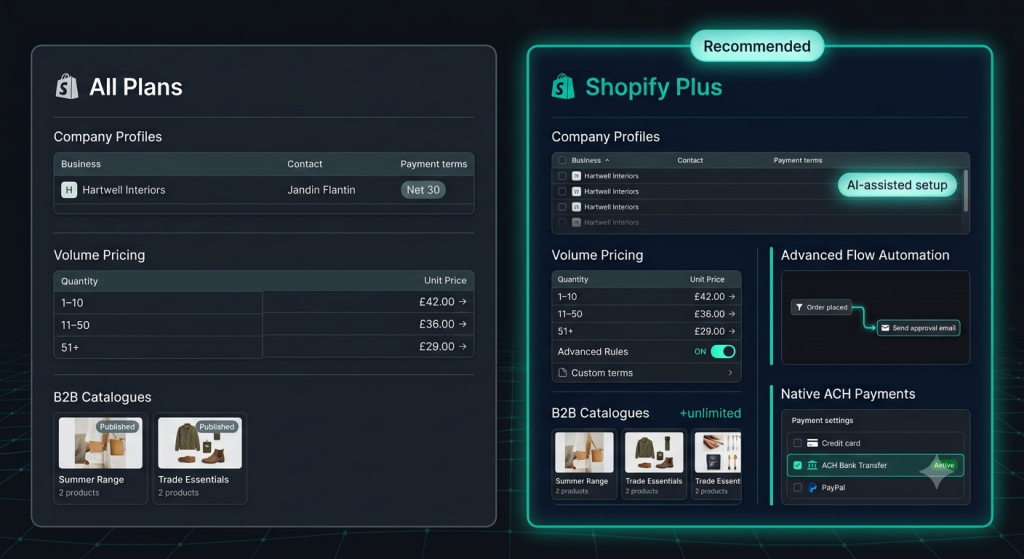
B2B features — company profiles, volume pricing, B2B catalogues, net payment terms — were previously exclusive to Shopify Plus. Plus starts at $2,300 per month. For a brand doing £3M in annual revenue with growing wholesale interest, that price point was a real barrier.
Spring ’26 changes that.
Company profiles, volume pricing, up to three B2B catalogues, and a B2B storefront experience are now available on Basic, Grow, and Advanced plans — at no additional cost.
This is not the full Shopify Plus B2B stack. Plus still delivers larger catalogue limits, advanced Flow automation, and native ACH support. But for brands exploring wholesale as a revenue channel, the barrier has dropped significantly.
A UK homeware brand approached by a handful of small retailers can now build a proper wholesale storefront on their current plan, validate demand, and upgrade to Plus only when the revenue justifies it — rather than committing to a significant monthly cost increase before a single wholesale order is placed.
Best for: DTC brands in the £1M–£10M range ready to test wholesale — without committing to Shopify Plus pricing upfront.
The Analytics Upgrade Merchants Have Been Waiting For
Shopify’s built-in analytics has long been the part of the platform merchants complain about most.
Good for tracking what happened. Weak on explaining why. Almost useless for answering what to do next.
Spring ’26 rebuilds it.
What’s new:
- Richer visualisations — scatter, radar, bubble, and sunburst charts now available in custom reports, making trends significantly easier to spot than standard bar charts and tables
- Daily AI insights — Shopify automatically surfaces your most important trends. You might open your admin on a Wednesday and see: “Mobile checkout abandonment has increased 14% over the past five days, concentrated at the payment step.” No custom report. No data query. Just the insight.
- Metric targets — Set targets for key metrics and track visual progress against them. The long-standing frustration — needing to export to a spreadsheet just to answer “are we on track this month?” — is resolved.
For a brand running a focused Q3 growth sprint, having all three inside the platform you already pay for removes an entire layer of the analytics stack that was previously held together by CSV exports and a Google Sheet.
Worth doing this week: Open your analytics dashboard — daily insights are already live. No setup required.
POS v11: The Fastest In-Person Experience Yet
For merchants with physical retail alongside their online store, Spring ’26 delivers POS v11 — their fastest-ever point-of-sale interface, with over a minute saved per transaction.
On a busy retail floor, that minute compounds across every customer interaction over a trading day. Staff at Province of Canada — a Shopify case study retailer — felt the difference immediately.
What’s new in POS v11:
- In-store pickup order management from any retail location (create, notify, fulfil)
- Scannable QR code discounts applied at checkout when a customer presents their phone
- Returns and exchanges processed in a single cart — the previous two-step workflow is gone
The new Verifone Victa Mobile — a handheld device that functions as both a barcode scanner and card terminal on the floor, and docks as a full POS terminal when stationary — is available for pre-order in the US and Canada. UK merchants should watch this closely as availability expands.
For brands building proper omnichannel operations, POS v11 reinforces the structural advantage of running everything through Shopify. Inventory, customer data, order management, and reporting are unified across online and in-store from a single admin. The full case for Shopify POS in retail is worth reading alongside this update.
The Quieter Wins Worth Acting On
Not every meaningful Spring ’26 update comes with a headline.
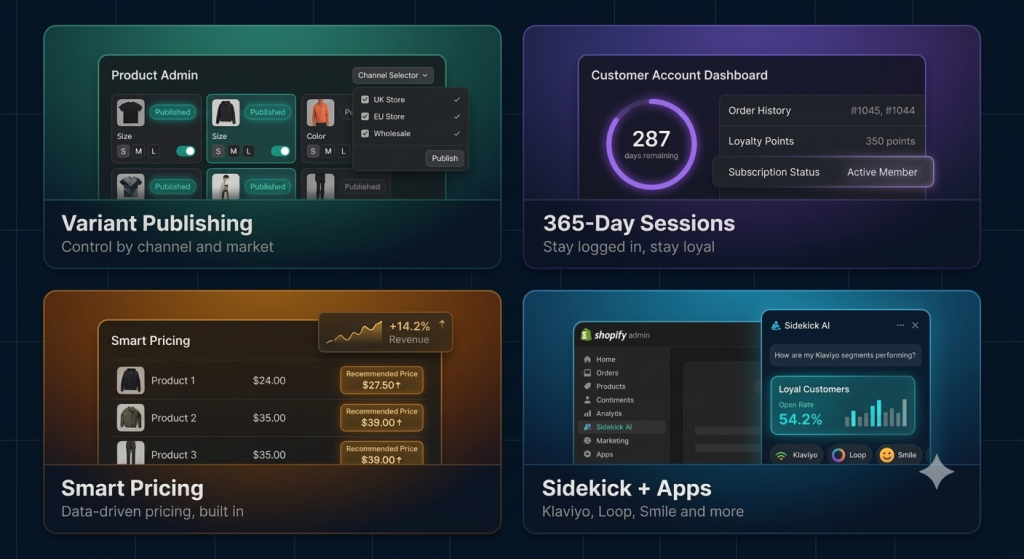
Variant-level publishing — Control which product variants are published by channel and by market, without any workarounds. Make certain colourways available only in specific markets, or exclude out-of-season sizes from a particular channel — without duplicating your product structure.
365-day customer account sessions — Customers stay logged in for a full year without being forced to re-authenticate. For brands where the account experience — order history, subscription management, loyalty access — is a meaningful part of retention, this removes friction that previously nudged customers away from staying signed in.
Shopify Smart Pricing — A new native app surfacing product-level pricing recommendations based on sales data, inventory levels, costs, and seasonality. For brands managing large SKU counts without a dedicated pricing function, this replaces a process that previously required a third-party tool or a manual spreadsheet.
Sidekick now works with third-party apps — Starting with Judge.me, Klaviyo, Loop, and Smile. Ask Sidekick about your review performance, loyalty programme data, or subscription metrics without switching context. The Shopify admin is increasingly becoming the single operational surface most merchants have wanted.
Where Should You Focus First?
Spring ’26 is not a release you evaluate whether to adopt — it is already live on your store. The question is where to direct your implementation energy.
If you’re a DTC brand with international ambitions: Prioritise AI commerce and Campaign Autopilot. Structuring your catalogue for AI channel performance is a near-zero-cost action with compounding upside.
If you’re exploring wholesale: Now is the time to build. The Plus price point is no longer the prerequisite it was.
If you have physical retail: Install POS v11 before your next peak trading period.
If AI channels still feel premature: Start with the analytics rebuild and 365-day account sessions. Both improve core operations immediately, with no additional integration overhead.
Ready to Get More From Shopify Spring ’26?
As a Shopify Plus Partner, Sweans works with growing brands to cut through platform releases and implement what actually moves the needle. Our Shopify development team works from strategy through to implementation.
If Spring ’26 has surfaced priorities you need to act on, book a free 30-minute consultation and we will help you identify where to start.
