


Cash on Delivery remains an important part of ecommerce in India.
For many customers, especially first-time buyers or shoppers who are not comfortable paying online before receiving an order, COD can remove a major barrier to purchase.
For merchants, however, COD creates a different challenge.
An order can be placed without an upfront payment, but the operational cost begins immediately. The product needs to be packed, dispatched and transported. If the customer refuses the parcel, cannot be reached, provides an incorrect address or simply changes their mind, the shipment may return to the seller.
That is Return to Origin (RTO). The solution isn’t necessarily to remove COD.
For many Indian Shopify stores, the better approach is to make COD more controlled, measurable and selective.
Why Removing COD Isn’t Always The Answer
It is tempting to look at high RTO and conclude that COD should simply be disabled. But payment behaviour isn’t identical across every customer segment, product category or region. Removing COD can also introduce friction for customers who genuinely prefer it.
Instead, merchants can separate the real problem into smaller questions:
- Which COD orders are risky?
- Why are customers refusing deliveries?
- Which locations generate disproportionate RTO?
- Are customers entering incomplete addresses?
- Are fake orders being placed?
- Can some COD customers be converted to prepaid?
- Should COD be available for every product and every order value?
Once these questions are answered, Shopify can be configured around the actual problem rather than treating every COD order the same way.
Start by measuring your COD funnel
Before changing the checkout experience, understand what is happening.
Track at least these stages:
COD orders → verified orders → dispatched orders → delivered orders → RTO orders
Then segment the data by:
- Pincode
- State
- Product
- Order value
- New vs returning customer
- Customer history
- Courier
- Delivery attempts
- COD vs prepaid
This can reveal patterns that aren’t visible in your overall RTO percentage.
For example, a store might discover that most COD orders are delivered successfully, but a small group of pincodes generates a disproportionate number of failed deliveries.
That calls for a different solution from simply disabling COD nationwide.
1. Verify COD orders before shipping
One of the simplest ways to reduce avoidable COD losses is to confirm that the customer actually wants the order.
This can be done through:
- OTP verification
- SMS confirmation
- WhatsApp confirmation
- IVR calls
Several Shopify COD solutions currently support these workflows, allowing merchants to verify orders before they are fulfilled.
The basic flow can look like this:
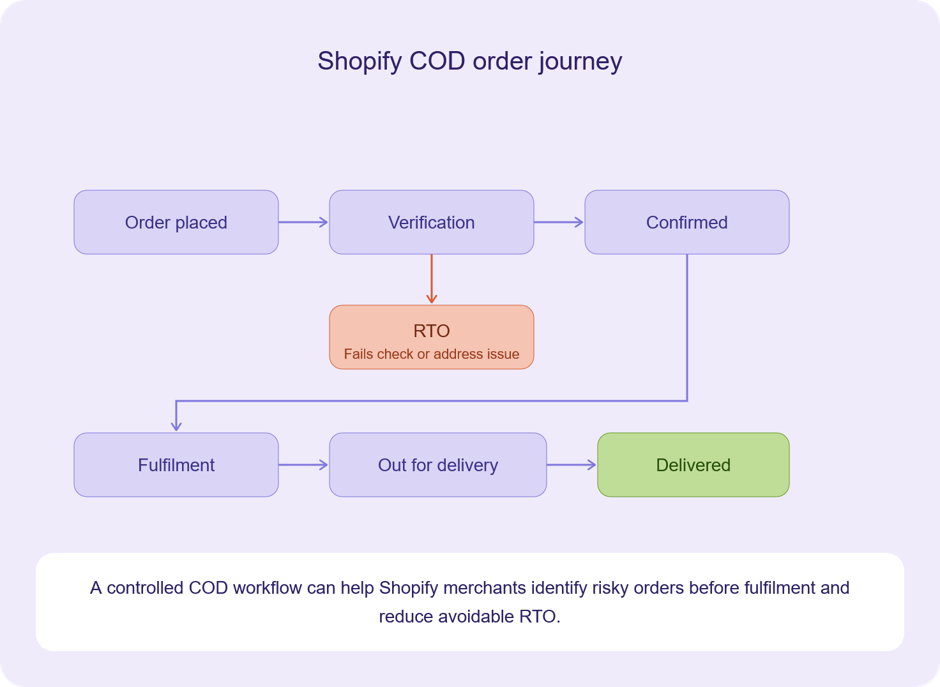
Customer places COD order → verification message sent → customer confirms → order is released for fulfilment
If the customer doesn’t confirm within a defined period, the order can be held for review or cancelled depending on the merchant’s rules.
This adds a small step, but it can prevent a much larger fulfilment and reverse-logistics cost.
2. Don’t treat every COD customer as high risk
Verification should be intelligent rather than unnecessarily aggressive.
A returning customer with several successful prepaid and COD deliveries shouldn’t necessarily receive the same treatment as a first-time customer placing a high-value COD order from a location associated with repeated RTO.
You can consider signals such as:
- Previous successful orders
- Previous RTO history
- Order value
- Pincode
- Product category
- Customer account history
- Phone verification status
This allows merchants to build rules around risk instead of inconveniencing every customer.
For example:
Low-risk customer: COD available immediately.
New customer: COD verification required.
High-value COD order: OTP plus partial payment.
Repeated RTO customer: COD restricted or unavailable.
The exact rules should be based on the store’s own order data.
3. Use partial payment for higher-risk COD orders
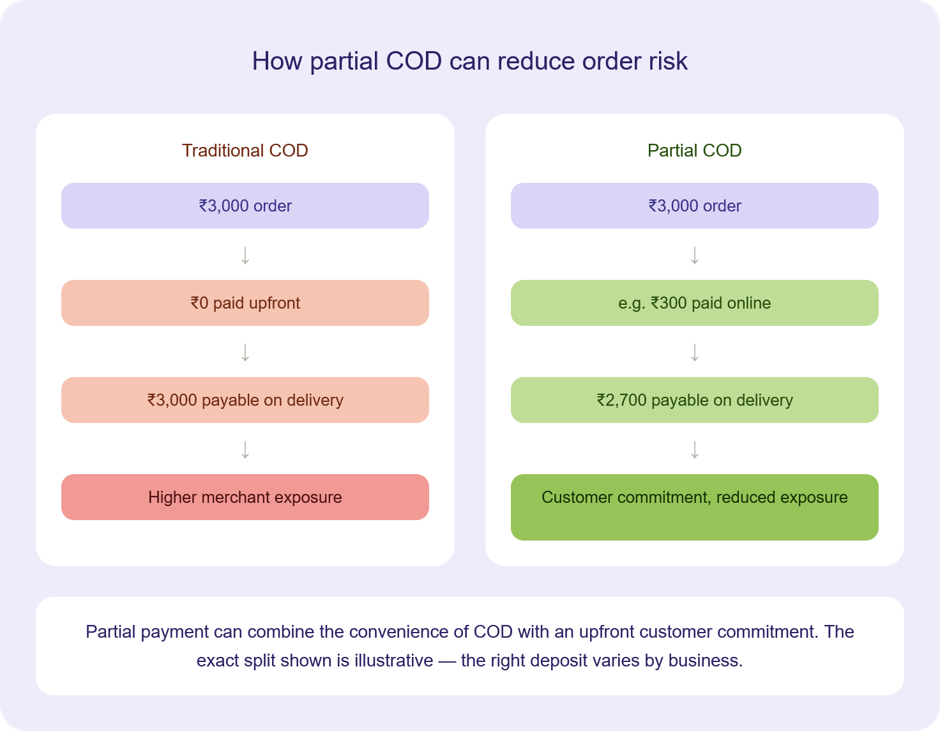
Another option is to collect a small amount upfront and keep the remaining amount payable on delivery.
This creates a financial commitment without completely removing the customer’s preferred payment method.
Shopify COD solutions currently support partial or upfront payment models alongside COD verification.
For example, instead of:
₹3,000 order → ₹0 paid upfront → ₹3,000 COD
a merchant could use:
₹3,000 order → ₹300 paid online → ₹2,700 COD
The amount and eligibility rules should depend on the merchant’s margins, customer behaviour and logistics costs.
The important principle is that the upfront amount should be designed to reduce genuine operational risk without creating unnecessary checkout friction.
4. Give customers a reason to choose prepaid
Reducing COD does not always require penalising customers.
You can also make prepaid more attractive.
For example:
“Pay online and get an additional 5% off.”
Or:
“Prepaid orders receive free express delivery.”
This creates a positive reason for customers to choose digital payment.
The incentive needs to be financially sensible. If a discount costs more than the expected COD/RTO savings, it doesn’t solve the underlying problem.
The right approach is to compare:
Prepaid incentive cost
against
Expected COD fulfilment + RTO cost
and measure the resulting conversion and delivery rates.
5. Consider a COD fee carefully
Some Shopify COD solutions allow merchants to add a separate COD charge.
For example:
Prepaid: Free shipping
COD: ₹49 COD handling fee
This can help offset some of the additional operational cost and encourage customers who are comfortable paying online to choose prepaid.
However, the fee should be tested rather than introduced blindly.
If customers interpret the charge as a penalty, it could increase checkout abandonment.
A/B testing different approaches – COD fee, prepaid discount, free prepaid shipping or no incentive—can provide a clearer picture of what works for a specific customer base.
6. Validate addresses before shipping
Not every RTO is caused by fraud.
Sometimes the problem is simply bad delivery information.
Common issues include:
- Incorrect pincode
- Missing apartment or house number
- Incomplete locality
- Incorrect phone number
- Duplicate or suspicious addresses
- Pincode and city mismatch
Address validation can therefore be as important as fraud detection.
A Shopify store can use validation rules, pincode serviceability checks and customer confirmation workflows before an order reaches fulfilment.
This is especially important for merchants operating across India, where delivery conditions can vary considerably between locations.
7. Use location-based COD rules
COD doesn’t have to be a universal payment option.
Shopify merchants can build rules around factors such as:
- Pincode
- Cart value
- Product
- Customer history
- Shipping availability
Some current Shopify COD solutions specifically support rules for controlling COD based on location, cart value and products.
For example:
COD available: Orders below ₹5,000 in serviceable locations.
COD unavailable: Certain high-RTO pincodes.
Partial COD: Orders above ₹5,000.
Prepaid only: Products with high return or shipping costs.
This can be considerably more effective than a blanket “COD on” or “COD off” decision.
8. Improve COD communication after checkout
A customer who places a COD order shouldn’t be left wondering what happens next.
Clear communication can include:
Immediately after ordering:
“Your COD order has been received.”
Before dispatch:
“Please confirm your order to proceed with shipping.”
After dispatch:
“Your order has been shipped.”
Before delivery:
“Your order is arriving today. Please keep ₹X ready.”
This can reduce avoidable delivery failures caused by customers forgetting about an order or being unavailable when the courier arrives.
WhatsApp, SMS and email can be combined depending on the customer’s communication preferences and the merchant’s technology stack.
9. Don’t ignore the prepaid payment experience
COD optimization should not happen in isolation.
If prepaid payments fail frequently or the checkout experience looks unreliable, customers may choose COD simply because it feels safer.
For more on identifying checkout and UX issues that can prevent customers from completing purchases, see our guide:
Traffic but No Sales? A Shopify UX Conversion Check
For Indian Shopify stores, payment infrastructure needs to support the payment methods customers actually use.
Sweans’ work with Indian ecommerce brands such as Casio India has included Shopify Plus development and Razorpay integration supporting UPI, cards, wallets, net banking and EMI options.
A smoother prepaid experience can therefore be part of the solution to COD dependency.
10. Keep an eye on India’s changing payment environment
The economics of digital payments are also evolving.
From October 15, 2026, a 0.4% merchant discount rate is scheduled to apply to UPI person-to-merchant transactions above ₹2,000, with specific exemptions and caps. Reuters reported that the change ends the previous zero-fee model for the affected transactions.
For Shopify merchants, this makes payment-cost monitoring even more relevant.
The answer isn’t necessarily to push customers toward COD. Instead, merchants should understand the total cost of each payment method—including payment processing, fulfilment, RTO, returns and customer service—before deciding how payment options should be structured.
Build a COD strategy around your actual data
There is no single COD setting that works for every Shopify store.
A fashion brand, electronics retailer, beauty brand and furniture business may have completely different COD behaviour.
That’s why the first step should be measurement.
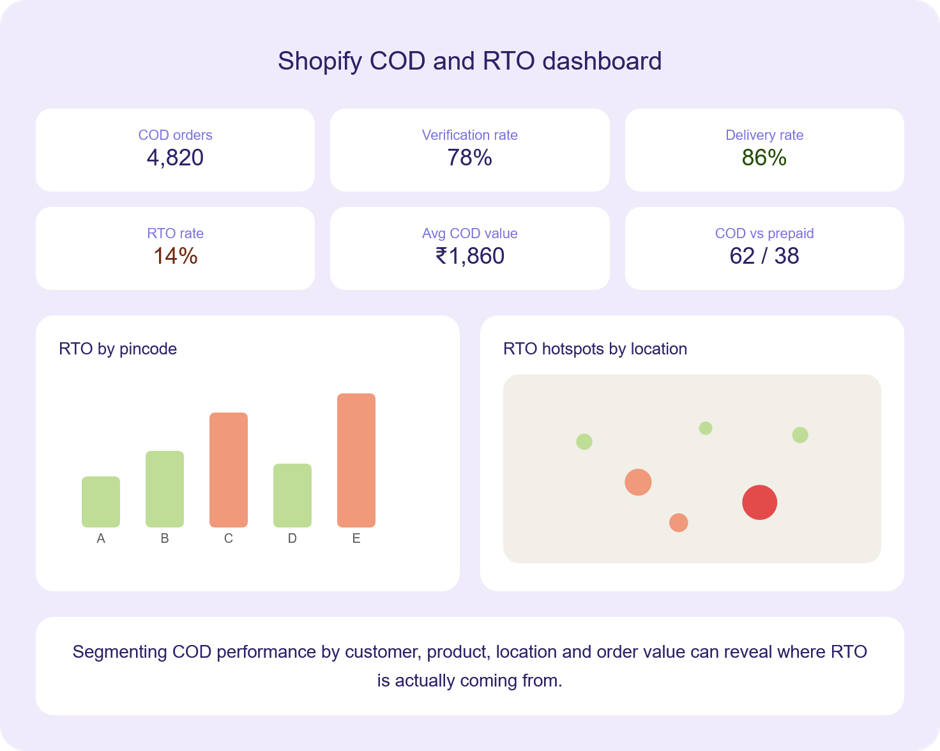
Look at:
- COD conversion rate
- COD verification rate
- COD delivery rate
- RTO rate
- RTO cost
- Average COD order value
- Prepaid conversion rate
- RTO by pincode
- RTO by product
- RTO by customer segment
Then use those findings to decide which controls are necessary.
The goal isn’t to eliminate COD.
The goal is to make COD commercially sustainable.
COD should be a controlled payment option, not an uncontrolled risk
Cash on Delivery can still play an important role in India’s ecommerce market.
But merchants don’t have to choose between accepting every COD order and removing COD completely.
Shopify gives merchants the flexibility to build a more controlled payment experience through verification, conditional payment rules, prepaid incentives, partial payments, address validation and customer communication.
The right strategy is usually a combination of these tools, based on actual store data.
For growing Shopify brands, this is where development, payments, logistics and CRO start to overlap. A COD problem that looks like a payment issue may actually be caused by checkout UX, customer communication, fulfilment rules or poor order data.
At Sweans, we work with Shopify and Shopify Plus brands on custom development, payment integrations, app development, UX, CRO, and ecommerce optimisation. That means looking beyond simply adding a COD app and designing an order flow around the merchant’s actual business model.
If COD orders are driving high RTO, unnecessary logistics costs or operational overhead for your Shopify store, a data-led checkout and COD review can help identify where the biggest losses are occurring – and which parts of the customer journey can be improved.
