

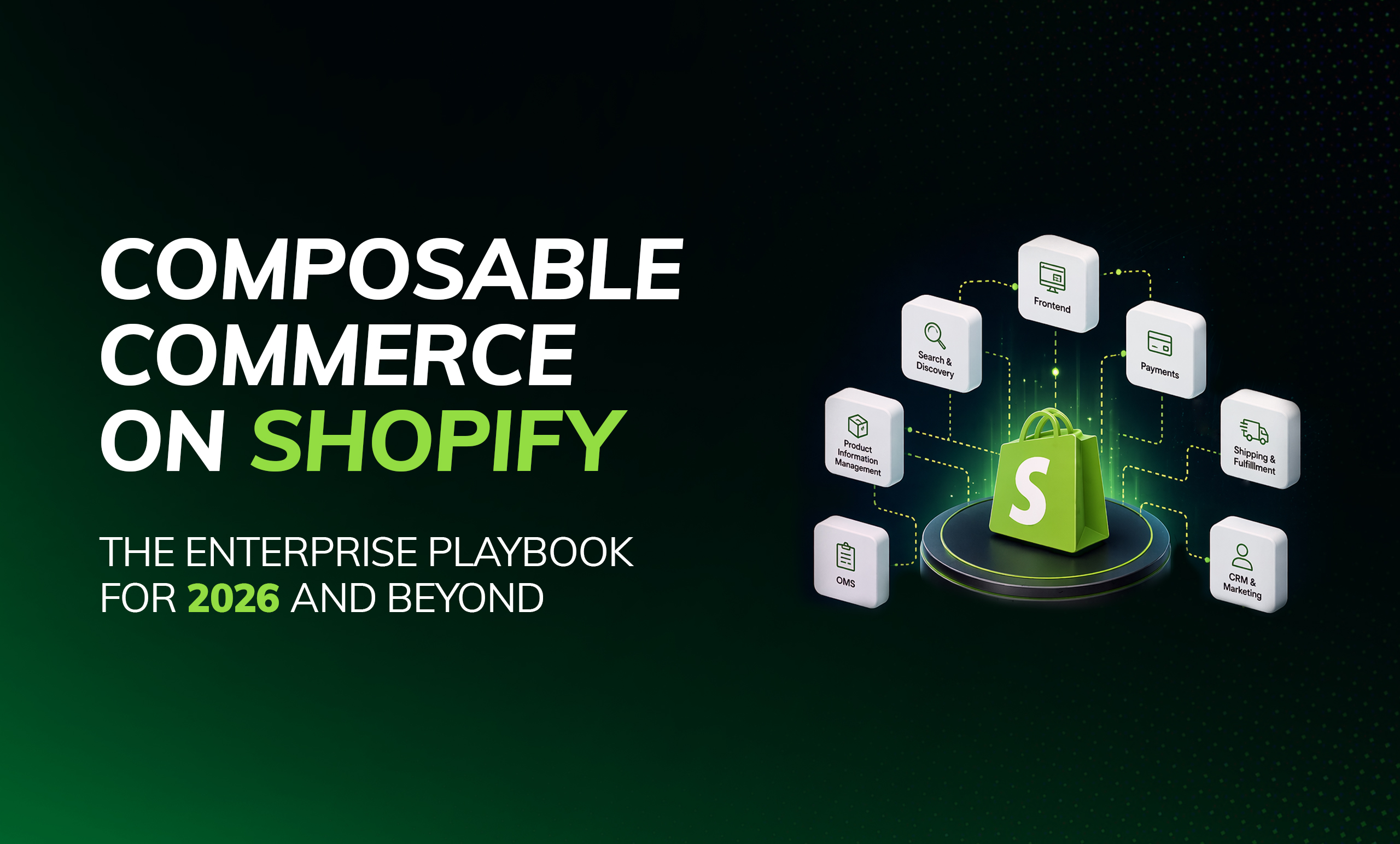

There’s a question coming up more and more in boardrooms, product teams, and digital agencies around the world: is our e-commerce platform still keeping up with what our customers expect and what our business actually needs?
For many enterprise brands, the honest answer is no.
The encouraging part is that Shopify anticipated this shift early. Well before “composable commerce” became a common term, Shopify was already investing in the kind of infrastructure that supports it. Its modular, API-first, developer-friendly ecosystem gives brands the freedom to build the commerce experience they want instead of working around the limits of a one-size-fits-all platform.
This guide is for digital leaders, brand managers, and CTOs who want to see how composable commerce on Shopify works in the real world and decide if it makes sense for their business in 2026.
Why the “All-in-One” Model Is Reaching Its Ceiling
For years, the pitch from e-commerce platforms was simple: everything you need, in one place. A storefront, a CMS, a checkout, a payment gateway, and an inventory system, all bundled together, tightly coupled, and maintained by a single vendor.
That model worked brilliantly at a certain scale. But as brands grew more sophisticated, that same simplicity became a constraint.
Consider the common frustrations that enterprise merchants face:
Performance bottlenecks. Monolithic storefronts are often slower because every page request travels through the same server-side rendering pipeline, regardless of how complex or simple the content is. In 2026, when Google’s Core Web Vitals directly influence search rankings and milliseconds influence conversion rates, slow is not an option.
Design rigidity. When your storefront and your commerce logic are tightly coupled, changing how a product page looks often means changing how it functions. Editorial teams can’t move independently of developers.
Localisation constraints. Global brands need different content, currencies, tax logic, and even entirely different catalogue structures for different markets. Traditional monolithic platforms struggle to serve twelve markets with twelve distinct experiences from a single codebase.
Integration debt. Modern brands operate a stack of best-of-breed tools: a dedicated PIM (Product Information Management system), a CDP (Customer Data Platform), a loyalty engine, and a headless CMS. Getting all of these to talk to a tightly coupled platform is painful, brittle, and expensive to maintain.
This is where composable commerce changes everything.
What Composable Commerce Actually Means
Composable commerce is not a product. It is an architectural philosophy. At its heart, it means building your commerce experience by selecting and assembling best-of-breed components rather than accepting a single vendor’s entire stack.
The concept is often described through the acronym MACH:
- M — Microservices: Individual business capabilities (checkout, search, inventory) deployed as independent services
- A — API-first: Every capability is accessible and composable via APIs
- C — Cloud-native: Scalable, globally distributed infrastructure with no single point of failure
- H — Headless: The frontend presentation layer is fully decoupled from the backend commerce logic
What makes this exciting is not just the technical architecture. It is what that architecture enables for business. When your storefront, your checkout, your inventory logic, and your content layer are all independently deployable, you get:
- Frontend teams shipping new experiences without touching backend commerce logic
- Marketing teams publishing rich editorial content without developer bottlenecks
- Commerce logic (discounts, bundles, pricing) customised in code without compromising platform stability
- The freedom to swap out any individual component as your needs evolve
The question that matters is: Does Shopify support this?
The answer, especially for Shopify Plus merchants, is a resounding yes — and the stack is more mature than most brands realise.
Shopify’s Composable Commerce Stack: What It Looks Like in 2026
Shopify has spent the last several years systematically building the tooling required for composable commerce. Today, the platform offers a remarkably capable stack for brands ready to go this route.
1. The Shopify Storefront API: Your Commerce Backbone
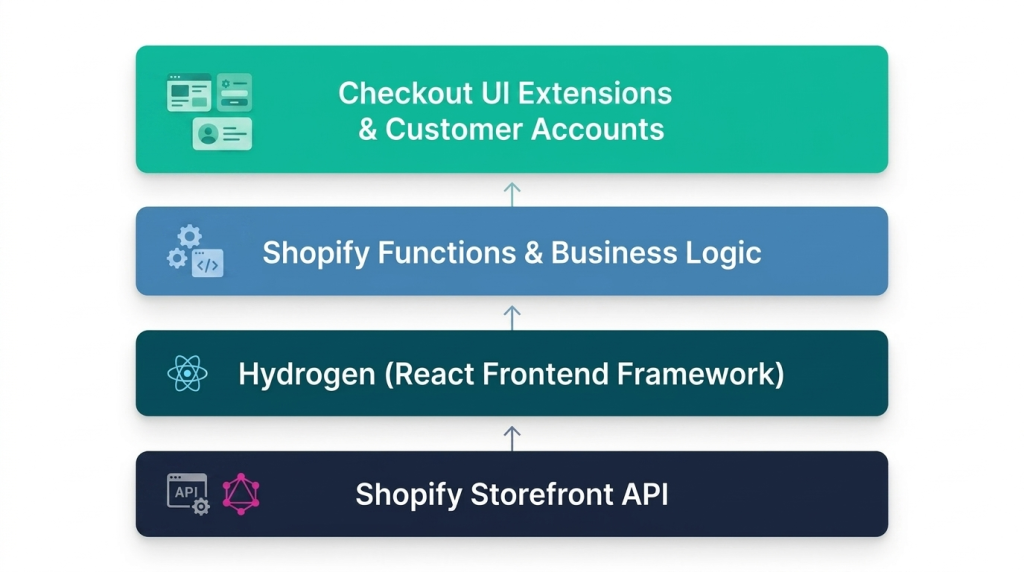
Everything in Shopify’s composable approach starts with the Storefront API — a powerful GraphQL API that exposes your entire Shopify store’s data to any frontend you choose. Products, collections, variants, metafields, customer data, cart state, and more — all available as structured data that your custom frontend can consume.
This is the foundation that makes headless and composable possible. Instead of your storefront being locked to Shopify’s Liquid templating system, your frontend can be built in any technology — React, Vue, Next.js, Remix — and simply pull the commerce data it needs.
2. Hydrogen: Shopify’s Official Headless Framework
For brands that want to go headless without starting from scratch, Shopify offers Hydrogen — a React-based framework built specifically for custom Shopify storefronts. Hydrogen gives developers a set of commerce-specific utilities, hooks, and components that handle the heavy lifting of integrating with Shopify’s APIs, so teams can focus on building the experience rather than the plumbing.
Hydrogen is particularly powerful for brands that want both performance and design freedom. Because the frontend is decoupled, pages can be rendered at the edge — meaning content is served from servers geographically close to each user, dramatically reducing load times.
3. Oxygen: Edge-Native Hosting Built for Hydrogen
Shopify’s Oxygen is the hosting platform designed to run Hydrogen storefronts at the edge. Rather than deploying your headless storefront to a traditional server, Oxygen distributes it globally across Shopify’s infrastructure network — the same network that powers millions of Shopify stores.
For brands, this means enterprise-grade reliability and performance without the complexity of managing their own cloud infrastructure. Oxygen includes zero-cost hosting for Hydrogen deployments on Shopify Plus, making it a genuinely compelling option for teams who want performance gains without infrastructure overhead.
4. Shopify Functions: Custom Business Logic at the Platform Level
One of the most transformative and often underappreciated additions to Shopify’s composable stack is Shopify Functions. Previously, merchants who needed custom logic in their checkout (complex discount rules, custom shipping calculations, payment method restrictions, subscription pricing) had to rely on Shopify Scripts, which were limited, slow, and eventually deprecated.
Shopify Functions replaces all of that with a far more powerful model: custom WebAssembly-compiled code that runs directly within Shopify’s infrastructure at checkout time. This means you can build:
- Complex B2B tiered pricing that adjusts based on customer segment, order volume, or company affiliation
- Custom discount stacking rules that go beyond what Shopify’s native discount engine supports
- Personalised shipping options that factor in custom criteria (delivery zones, product categories, loyalty tier)
- Payment customisation — showing or hiding specific payment methods based on cart composition or customer data
All of this runs at Shopify’s infrastructure level — not on an external server — which means it is fast, scalable, and does not break under traffic spikes.
5. Checkout UI Extensions: Composable Checkout Experiences
The checkout is the most critical moment in any customer journey, and Shopify gives Plus merchants the ability to extend it significantly through Checkout UI Extensions. These allow brands to inject custom UI components directly into the Shopify checkout flow — things like:
- Post-purchase upsell blocks
- Custom gift message fields
- Loyalty programme status and point redemption
- Delivery date pickers
- Social proof widgets (real-time stock levels, customer reviews)
- Consent and compliance capture for regulated markets
Because these extensions run within Shopify’s checkout (rather than replacing it), merchants retain all of Shopify’s checkout security, PCI compliance, and conversion optimisation — while customising the experience to match their brand and business needs.
6. Customer Account Extensibility
Launched as part of Shopify’s ongoing commitment to composable experiences, Customer Account Extensions let brands build custom UI within the new customer account experience. They make it possible to add features like order tracking integrations, loyalty dashboards, subscription management interfaces, and returns portals that feel native instead of bolted on.
For subscription-led DTC brands or loyalty-heavy retailers, this is significant: your customer’s post-purchase world can now be as carefully crafted as your storefront.
Why Shopify’s Approach Is Different from “Build It Yourself” Composable
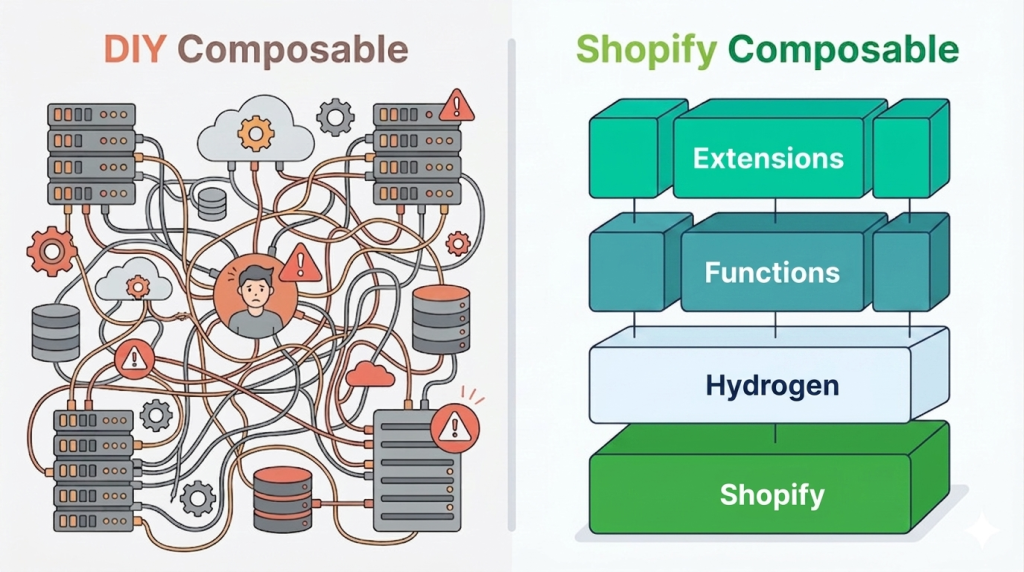
It is worth pausing here to address a real tension. True MACH architecture can mean assembling a commerce stack from scratch — your own microservices, your own APIs, your own infrastructure. Some brands and agencies champion this approach.
The risk? Enormous complexity, long build timelines, high engineering cost, and the burden of maintaining the entire stack yourself. For most brands, this is a poor trade.
What makes Shopify’s composable approach compelling is that it lets you compose the experience without having to rebuild the commerce infrastructure. You don’t need to build your own payment processing, fraud detection, tax calculation engine, inventory management system, or order routing. Shopify handles all of that — at 99.99% uptime, at massive scale, with global support — while giving you the APIs and extensibility to build precisely the storefront, checkout, and customer experience you want on top.
This is sometimes called semi-composable or composable-at-the-edges architecture — and for most growing enterprise brands, it is the pragmatic, commercially sensible path to the flexibility they need without the risk of owning every layer.
Real-World Use Cases: What Composable Shopify Looks Like in Practice
Luxury Fashion: Editorial Storytelling Meets High-Performance Commerce
A premium fashion label with seasonal drops and editorial-driven content needed a storefront that could handle richly produced, image-heavy campaign pages — without the Liquid templating constraints of a standard Shopify theme.
Their solution: a Hydrogen-powered headless storefront, with editorial content served from a headless CMS and product data pulled from Shopify’s Storefront API. The result was a storefront that loaded campaign pages in under 1.5 seconds globally, with content teams able to publish lookbooks and editorial features independently of developers. Conversion improved markedly — not just from speed, but from the ability to run rich, immersive product stories that a standard Shopify theme would never have supported.
B2B Manufacturing: Custom Pricing Logic for Complex Buyer Relationships
A European industrial manufacturer using Shopify B2B needed pricing logic that reflected their complex tiered relationships — different prices for different buyer tiers, volume-based discounts that stacked with contractual terms, and payment method restrictions for certain customer segments.
Shopify Functions made this possible within the Shopify checkout without the need for external APIs or custom server infrastructure. Their development team wrote custom pricing and discount Functions that ran within Shopify’s infrastructure, making the checkout experience feel seamless for buyers while reflecting the full complexity of the brand’s wholesale relationships.
Multi-Market Retailer: Localised Experiences from a Shared Commerce Core
A health and wellness brand selling across the UK, EU, and Middle East needed storefronts that were genuinely localised — not just translated, but adapted in terms of content, imagery, regulatory disclaimers, and local payment preferences.
Using Shopify’s Storefront API, Shopify Markets for currency and tax handling, and Hydrogen for the frontend, they built three distinct storefront experiences that shared a single Shopify backend. Editorial content for each region was managed in a headless CMS and surfaced in the appropriate storefront. Each storefront performed independently, could be updated independently, and was served from the edge to users in each region.
Is Composable Commerce Right for Your Brand? An Honest Assessment
Not every brand needs composable architecture — and part of getting this right is being honest about when it adds genuine value versus when it adds unnecessary complexity.
Composable on Shopify is the right move when:
- Your annual GMV is above £5–10 million, and you are starting to hit the walls of what standard themes can deliver
- You have dedicated front-end development capacity (in-house or agency), comfortable with React-based development
- Your brand experience demands — rich editorial content, complex interactivity, ultra-fast performance — go beyond what Liquid themes can provide
- You operate across multiple international markets with genuinely different experience requirements
- You need custom business logic (complex pricing, discount stacking, B2B relationships) that standard Shopify apps can’t handle elegantly
- You have a longer-term investment horizon and understand that composable builds take longer upfront but deliver greater flexibility over time
Composable is likely overkill when:
- You are in the early growth stage (under £1–2M GMV) and still validating your market
- You do not have a dedicated engineering resource — composable requires ongoing developer investment
- Your customer experience needs are well-served by modern Shopify themes (which, in 2026, are genuinely powerful)
- Speed to market is your primary constraint, and you need to launch in weeks, not months
The honest answer for many brands is a phased hybrid approach — starting with a premium Shopify theme, introducing Checkout UI Extensions for quick wins, and gradually moving towards a Hydrogen-powered headless frontend as your scale and team capacity support it. This is exactly the kind of strategic roadmapping that an experienced Shopify Plus Partner can guide.
Getting Started: A Practical Composable Migration Roadmap
If your brand is ready to explore composable commerce on Shopify, here is a practical framework for approaching the transition.
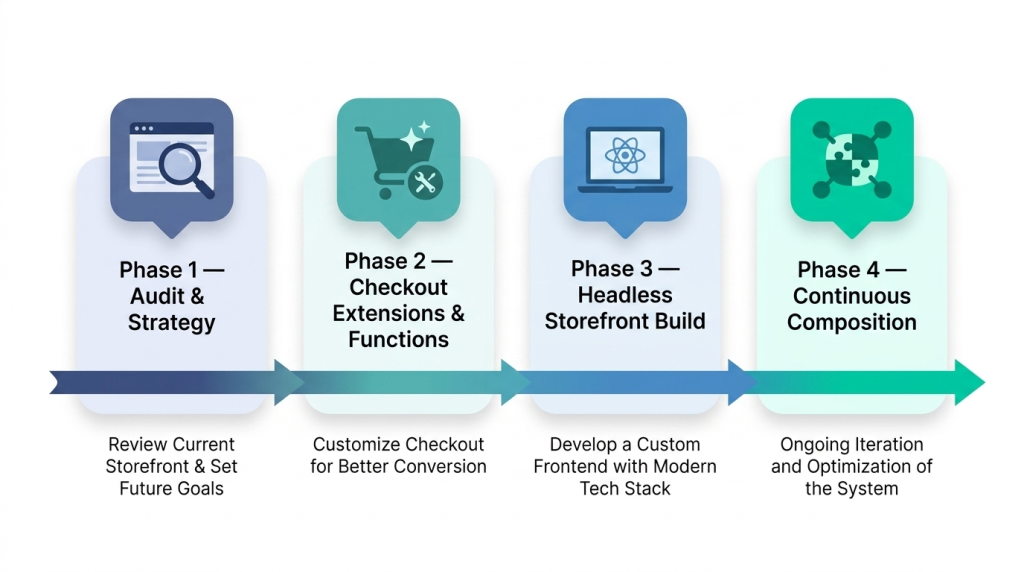
Phase 1 — Audit and Strategy (4–6 weeks)
Map your current tech stack: storefront, CMS, PIM, CDP, loyalty, ERP integrations. Identify where the friction is. Which experiences are underperforming? Which business logic is hacked together with workarounds? Where are your developers most constrained? This audit forms the foundation of your composable strategy.
Phase 2 — Quick Wins with Checkout Extensions and Functions (6–10 weeks)
Before committing to a full headless build, extract significant value from Checkout UI Extensions and Shopify Functions. Custom checkout UI, complex discount logic, upsell blocks — all of these can be delivered while your team plans the bigger move. These are lower-risk, faster-return changes that immediately demonstrate the value of composable thinking.
Phase 3 — Headless Storefront Build with Hydrogen (3–6 months)
If the audit confirms that a headless storefront is right for your brand, this is where the larger investment goes. A Hydrogen-powered storefront, connected to your chosen headless CMS and deployed on Oxygen, gives your brand the editorial and design freedom you need. This phase requires close collaboration between design, engineering, and commerce strategy teams.
Phase 4 — Continuous Composition (Ongoing)
The real benefit of composable architecture is that it never stops compounding. Once your foundation is in place, swapping in best-of-breed tools becomes far simpler. New loyalty platform? API integration. Better search experience? Drop in a dedicated search provider. New personalisation layer? Add it to your composable stack. This is the long-term strategic advantage composable commerce delivers.
Questions to Ask Before You Start
Before briefing any agency or internal team on a composable commerce project, get clear answers to these questions:
- What are the specific business problems we are trying to solve — and are they genuinely problems that composable architecture addresses?
- Do we have the engineering capacity to build and maintain a composable storefront, or do we need a long-term agency partner?
- What does our international footprint look like, and how complex are our localisation requirements?
- How critical is storefront performance to our conversion — and what does our current Lighthouse or Core Web Vitals score look like?
- What are our custom business logic requirements (pricing, discounts, B2B, subscriptions) and can they be served by Shopify Functions?
- What is our timeline and investment appetite — and are we ready for a build that takes months to deliver but years to pay off?
What You Get at Sweans
As a Premier Shopify Plus Partner headquartered in London, Sweans has spent years helping enterprise brands move beyond the standard storefront model — building bespoke, high-performance e-commerce experiences that scale with ambition.
